

Project documentation
The iron, the water, the depth, and the coordination, captured safely.
Heavy civil
Water lines, road bases, erosion protection, and bridge work are the infrastructure everything depends on, and almost none of it is visible when the job is done. That is the job of heavy civil contractor marketing.
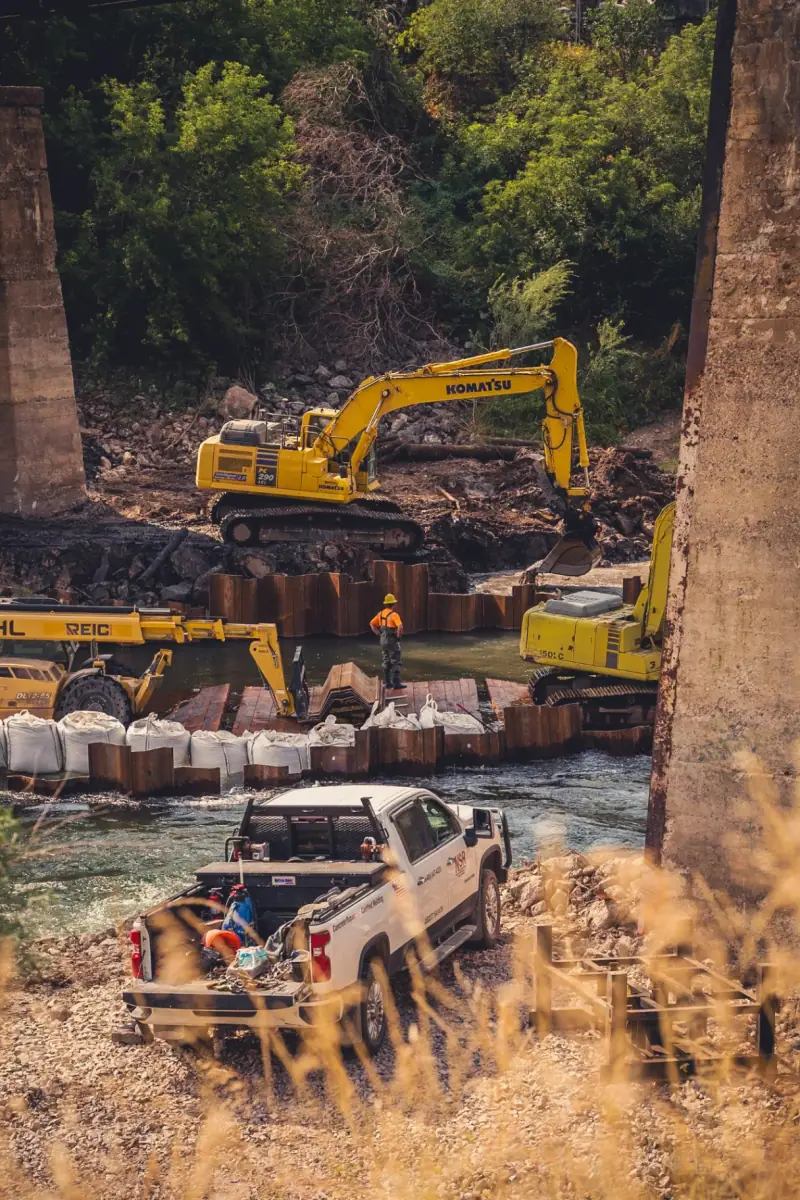
Water lines, sewer systems, road bases, erosion protection, structures under bridges: heavy civil and utility work is the infrastructure everything else depends on, and almost none of it is visible when the job is done. The public drives over it. The next owner never sees it.
That invisibility costs you. When a public agency, an engineer, or a private developer evaluates your firm, they are looking for evidence of capability: the scale of work you have handled, the conditions you have solved, the way your crews run a site. If that evidence only exists in old bid tabs, you are underselling the operation.
Who you are trying to win. Public works directors, engineers, agencies, and developers who care about safety records, equipment, crew depth, and comparable completed work.
Use one piece or all of them. One plan keeps the film, the site, the feed, and the ads telling the same story.
The iron, the water, the depth, and the coordination, captured safely.
An introduction for owners and agencies who have not worked with you yet.
An engineer finds a comparable project in seconds.
Operators and pipelayers see careers most people never knew existed.
Heavy civil buyers are different from residential buyers. They are engineers, public works directors, and project managers who care about safety records, equipment, crew depth, and completed work in comparable conditions. Marketing for this world is not about looking flashy. It is about making capability easy to verify.
Documented projects do that. A film of your crew setting sheet piling in a river, photography of a utility install done right, a website that organizes your work by scope and sector: this is the material that supports a bid, a prequalification, and a reputation.
Project documentation captures the scale and the conditions: the iron, the water, the depth, the coordination. A brand and capability film introduces the operation to owners and agencies who have not worked with you yet. A website built for your sector organizes completed work so an engineer can find a comparable project in seconds.
Recruiting content matters here as much as anywhere in construction. Skilled operators, pipelayers, and supers are scarce, and they choose employers partly on what they can see. A visible, professional operation pulls better people.
Stronger prequalification packages. A reputation that reaches owners and agencies before the bid list. Better recruiting in a trade where the labor shortage is real. And a documented record of capability that compounds with every project.
Heavy work speaks for itself when someone finally shows it. The scale of the iron, the precision of the crew, the miles of pipe and grade: documented well, it turns an invisible operation into the obvious choice for the next owner, agency, or operator watching.
The recruiting case deserves its own mention. Heavy civil and utility work offers some of the best careers in the trades, and most young people have never seen it. Footage of a crew setting pipe at scale or running a spread across open country does more for recruiting than any job posting ever written. The companies that show the work get the applicants.
And when the bid list is the business, capability is the brand. A documented record of completed work, safe operations, and well run sites is what prequalification looks like when it is done right. Marketing here is not decoration. It is the evidence file, kept current, project after project, so the next owner, agency, or general contractor never has to take your word for anything, because the proof is already on record, well documented, and easy for anyone in the industry to find, review, and trust.
For heavy civil and utility contractors, project documentation and a capability film carry the most weight, with a website that organizes completed work by scope and sector.
An excavation company with the reputation and the crew, and a feed that showed none of it. Here is what changed when Kiln took over.
From the field notes: The real cost of a marketing hire versus a specialist crew
Yes. We coordinate with your superintendent, follow your safety requirements, and confirm active work zones before we arrive. Documentation never slows the operation.
You approve everything before it goes out. We can document work without revealing addresses, client identities, or sensitive details, and some material can stay internal for bids only.
Yes, but differently than residential. Your buyers are engineers, agencies, and developers verifying capability. Documented projects, a capability film, and a website organized by scope make that verification easy and support every bid and prequalification.
Yes. Skilled operators and pipelayers choose employers partly on what they can see. Films and photography of real projects show your equipment, your conditions, and your crew culture to the people you want to hire.
We take a small number of trades companies at a time, so each one gets our full attention. Applications are read personally by Corey.